

Duplex Steel S32205 EFW Pipes combine a two-phase austenitic-ferritic microstructure with Electric Fusion Welding to produce pipe that holds pressure, resists chloride attack, and outlasts standard austenitic grades in chemically aggressive service. The UNS S32205 grade also designated WNR 1.4462 delivers a minimum yield strength of 448 MPa, roughly double the yield of 316L, while carrying a Pitting Resistance Equivalent Number (PREN) above 34. Silver Tubes manufactures and supplies duplex stainless steel S32205 EFW pipes to ASTM A790 / ASME SA790 for oil and gas, desalination, marine, and chemical processing projects across India and export markets.
What Are Duplex Steel S32205 EFW Pipes?
UNS S32205 EFW Pipes are produced by forming plate into a cylinder and fusing the longitudinal seam by electric arc under controlled heat input, followed by full anneal and pickling per ASTM A790. The microstructure targets 50% austenite and 50% ferrite a balance that gives the grade its combined strength and corrosion resistance that neither phase achieves alone. S32205 welded pipes cover diameters where seamless mill production becomes uneconomical, typically above 16" OD, without sacrificing mechanical or corrosion performance relative to seamless equivalents.
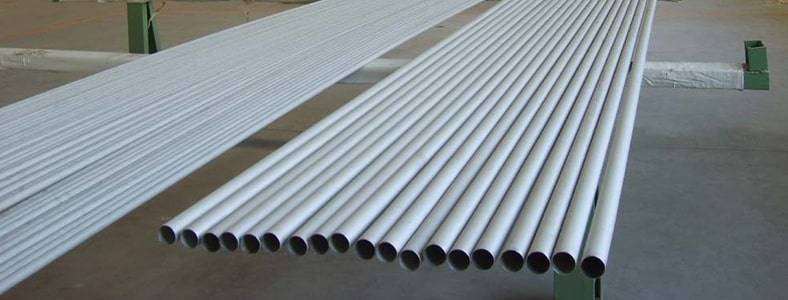
Duplex steel s32205 efw pipes are used in various applications like nuclear and thermal power generation, boiler equipment, sea water equipment or chemical industry and so on. We use best packing for deliver our product like wooden box packing, plastic bags, and bundle. We follow all the standard for manufacturing the product.
Duplex Steel S32205 EFW pipes, duplex steel S32205 EFW Pipes, S32205 EFW Square pipes Production Range and Specifications
Specifications: ASTM A/ASME A358, SA358
Standard : ASTM, ASME and API
Outside Diameter: 6.00 mm OD up to 914.4 mm OD, Sizes up to 24 NB available
Type: ERW, Welded
Thickness Range : 0.3mm 50 mm
Duplex Steel S32205 EFW Pipe Specifications
| Parameter | Details |
| Material Grade | UNS S32205 / WNR 1.4462 |
| Standard | ASTM A790 / ASME SA790 |
| Size Range | ½" NB to 24" NB (custom on order) |
| Wall Thickness | SCH 5S to SCH XXS |
| Length | 6m random; fixed lengths on request |
| End Types | Plain End, Beveled End, Threaded |
| Surface Finish | Annealed & Pickled, Bright Annealed |
Chemical Composition of UNS S32205
| Element | Content (%) |
| Chromium (Cr) | 22.0 – 23.0 |
| Nickel (Ni) | 4.5 – 6.5 |
| Molybdenum (Mo) | 3.0 – 3.5 |
| Nitrogen (N) | 0.14 – 0.20 |
| Manganese (Mn) | 2.0 max |
| Carbon (C) | 0.03 max |
| Iron (Fe) | Balance |
Mechanical Properties
| Property | Value |
| Tensile Strength | 620 MPa min |
| Yield Strength (0.2% offset) | 448 MPa min |
| Elongation | 25% min |
| Hardness (Brinell) | 293 HB max |
Key Features & Benefits
- High corrosion resistance — 22% chromium and 3% molybdenum push the PREN above 34, well past 316L's 24, which matters in any chloride-bearing stream where 316L pits within a single operating cycle.
- Stress corrosion cracking resistance exceeds what any fully austenitic grade delivers. The ferritic phase interrupts crack propagation through the matrix, a mechanism that keeps the pipe intact under combined chloride stress and tensile load.
- Superior strength-to-weight ratio cuts design wall thickness by 30-40% versus 316L for the same pressure class, reducing installed weight and weld volume on long pipe runs.
- Long service life follows from the corrosion data. Plants running S32205 in seawater and brine service report service spans exceeding 20 years without mid-life pipe replacement.
Advantages of Duplex Steel S32205 EFW Pipes
S32205 outperforms conventional 316L on three measurable fronts simultaneously: yield strength 2× higher, PREN 40% above 316L, and SCC immunity in chloride environments where austenitic grades fail by cracking rather than general corrosion. High-pressure systems benefit from thinner wall design, reducing both material cost per meter and total system weight. Maintenance intervals extend compared to 316L service in seawater, cutting turnaround cost over the plant's operating life.
Applications of Duplex Steel S32205 EFW Pipes
Discover how these hard and strong pipes are used in the industries to safely deliver aggressive and extremely corrosive process fluids.
Oil & Gas
Excellent resistance to sulfide stress cracking and high structural stress make them ideal for subsea flowlines, downhole completions, and sour gas collection lines.
Petrochemical
Perfect for corrosive, chloride-containing hydrocarbon streams in high pressure process systems to minimize wall thinning and mechanical joint failures during heat.
Chemical Processing
Dependably holds and moves aggressive organic acids, mixed chemicals and high temperature reactor pipework where typical grades incur significant localized corrosion.
Marine & Offshore Engineering
Ideal for seawater lift pipework, topsides and structural splash-zone elements for offshore platforms, withstanding continuous saltwater spray and strong chloride pitting attacks.
Desalination Plants
Used extensively in brine distribution headers and high pressure reverse osmosis feed lines subject to severe localized pitting in highly concentrated salt water solutions.
Production of Electricity
Provides long life for saltwater cooled heat exchanger circuits and power plant condenser tubing in harsh environments and prevents premature failure due to high velocity erosion-corrosion.
Pulp and Paper
Survives harsh bleach factory conditions, where pipe is constantly exposed to caustic chlorine dioxide and hypochlorite solutions with little degradation over time.
Available Types
- EFW Pipes (Electric Fusion Welded)
- Seamless Pipes
- Welded Pipes
- ERW Pipes
- Large Diameter Pipes (above 16" OD)
- Custom Fabricated Pipes (cut lengths, special end prep, non-standard schedules)
Testing & Quality Assurance
- Hydro Test — 1.5× design pressure per ASTM A790, minimum 5-second hold
- PMI Testing — 100% XRF on all heats against UNS S32205 chemistry limits
- Ultrasonic Testing — full-body and seam scan per applicable code
- Radiography Test — longitudinal seam on EFW pipes per ASTM E94
- Mechanical Testing — tensile, yield, elongation, and impact per ASTM A370
Why Choose Duplex Steel S32205 EFW Pipes?
Silver Tubes manufactures ASTM A790 Duplex Steel EFW Pipe across the full size and schedule range with in-house NDT, PMI, and hydrotest under one roof and one quality plan. Mill test certificates trace every shipment to heat number, with chemistry and mechanical data against UNS S32205 code limits. Export orders include commercial invoice, packing list, certificate of origin, and full code stamp documentation. Custom diameters and non-standard schedules go to drawing with formal approval before production starts.
Suppliers of Duplex Steel S32205 EFW Pipe to more than 60 countries for over 2 decades, we have our dealers & distributors in :
|
Mexico
|
Chile
|
Brazil
|
Peru
|
|
Kuwait
|
Jordan
|
Thailand (Bangkok)
|
Iran
|
|
Australia
|
New Zealand
|
Sri Lanka
|
Vietnam
|
|
Nigeria
|
Russia
|
Kazakhstan
|
Kazakhstan
|
Suppliers of Duplex Steel S32205 EFW Pipe to more than 60 Cities for over 2 decades, we have our dealers & distributors in :
FAQs
UNS S32205 is a duplex stainless steel grade with 22% chromium, 3% molybdenum, and 5% nickel in a balanced austenitic-ferritic microstructure, delivering 448 MPa minimum yield strength and a PREN above 34.
Electric Fusion Welded — plate or coil strip forms into a cylinder and the longitudinal seam closes by electric arc fusion under controlled parameters, then receives full anneal per ASTM A790.
S32205 tightens the S31803 chemistry: chromium minimum rises from 21% to 22%, molybdenum minimum from 2.5% to 3%, and nitrogen minimum from 0.08% to 0.14%. Those tighter limits guarantee a PREN above 34 on every heat. S31803 doesn't.
Yes, PREN above 34 and the ferritic phase's SCC resistance make S32205 the standard specification for offshore seawater piping and desalination brine lines where 316L pits and cracks under chloride load.
Oil and gas, petrochemical, desalination, marine and offshore, power generation, chemical processing, and pulp and paper, wherever chloride exposure, pressure above 100 bar, or SCC risk eliminates standard austenitic grades.