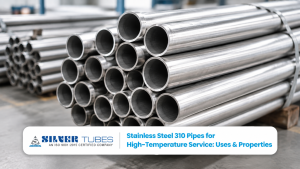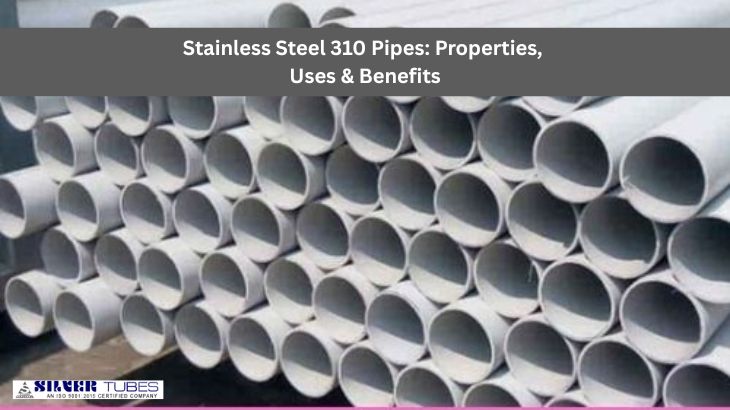
Furnaces, kilns, and heat exchangers push metal to temperatures where ordinary stainless steel scales, warps, or cracks within months. That’s usually where things go wrong. Stainless steel 310 pipes are built for this. They handle oxidation resistance up to around 1150°C and hold up in both oxidizing and carburizing conditions. That’s why engineers in petrochemical plants, power generation, and furnace fabrication keep specifying SS 310 pipes. The material simply holds its shape where lower grades fail. For continuous furnace runs, a lot of projects use Stainless Steel 310 seamless pipes since there’s no weld seam to worry about under thermal cycling. Below, we go through the properties, benefits, applications, and a few things worth checking before you choose 310 stainless steel.
What Are Stainless Steel 310 Pipes?
SS 310 pipes are in the austenitic stainless steel family but with a much higher chromium-nickel content than 304 or 316. Usually around 24-26% chromium and 19-22% nickel, plus carbon levels controlled enough to keep the structure stable when things heat up. That’s really what gives it the scaling resistance and lets it hold tensile strength past 800°C, somewhere 304 starts to give up. You’ll find these pipes made two ways. Seamless, through extrusion, which is what you want for pressure-heavy jobs. And welded, which works fine for bigger diameters where pressure isn’t as much of a concern. ASTM A312 TP310 pipes are the standard that covers dimensions, mechanical properties, and chemical limits for both, so it’s what most buyers check against. There’s also 310S, a lower carbon version, but standard 310 tends to do slightly better under continuous heat. Either way, neither 316 nor 304 gets close to the oxidation limit here.
Key Properties of Stainless Steel 310 Pipes
Excellent high-temperature strength: SS 310 pipes stay mechanically sound up to around 1150°C, which is well past what most austenitic grades manage in furnace or kiln work.
Superior oxidation resistance: High chromium content builds a stable oxide layer on the surface, so scaling isn’t really an issue even with repeated heating and cooling.
Outstanding corrosion resistance: Nickel above 19% helps it cope with oxidizing acids and carburizing atmospheres, which show up a lot in petrochemical lines.
High tensile strength: Tensile strength runs above 75,000 psi at room temperature, so it carries structural load in pressurized systems without bending out of shape.
Good weldability and fabrication: These pipes work fine with standard TIG or MIG welding, so building a piping network out of them isn’t complicated.
Excellent durability: It doesn’t embrittle easily from thermal shock, which is where a lot of other pipes give up under fast heating and cooling.
Long service life in harsh environments: Put the heat and corrosion resistance together, and it outlasts 304 or 316 in the same conditions, sometimes by years.
Applications of 310 Stainless Steel Pipes
Petrochemical plants: Process piping here carries corrosive feedstocks at high temperatures, and 310 stainless steel pipes deal with scaling and chemical attack at the same time.
Power generation facilities: Boiler tubes and steam lines use ASTM A312 TP310 pipes to take on sustained thermal stress without breaking down.
Heat exchangers: Tube bundles moving heat between fluids at high temperatures use SS 310, mainly for the oxidation resistance and thermal stability.
Furnaces and kilns: Muffle furnaces and industrial kilns use these as structural components, sitting right in the path of combustion heat.
Chemical processing plants: Reactors and transfer lines handling harsh chemicals at high heat rely on the dual resistance this alloy offers.
Oil and gas industries: Refinery units processing crude at high temperatures use SS 310 piping in catalytic cracking and reforming sections.
Boiler systems: Superheater tubes and boiler headers benefit from the creep resistance under constant pressure and heat.
Industrial process piping: General high-temperature transfer lines across manufacturing plants use 310 stainless because it holds up over time.
Factors to Consider When Choosing Stainless Steel 310 Pipes
Start with operating temperature and pressure. These two decide wall thickness and whether you go seamless or welded. Seamless suits high-pressure systems, since there’s no weld seam to fail. Welded works fine for bigger diameters at moderate pressure and usually costs less. Wall thickness and dimensions need to match the flow rate and structural load, so it’s worth checking specifications against ASTM A312 TP310 before placing an order. Corrosion exposure isn’t the same across industries either. Petrochemical plants deal with sulfur and acid attack, power plants deal with oxidation from continuous combustion, so the grade needs to suit the actual environment. And always ask for material certifications and mill test reports. That confirms the batch actually meets the chemical composition and mechanical properties stated in the order, which matters more than people think when substandard material slips through.
Conclusion
Stainless steel 310 pipes bring high-temperature strength, oxidation resistance, and corrosion resistance together in one alloy, which is why they hold up in furnaces, boilers, heat exchangers, and chemical lines where standard grades don’t. The chromium-nickel composition is really what makes the difference. Choosing SS 310 pipes with proper certification and ASTM A312 TP310 compliance means fewer breakdowns, less maintenance, and a pipe that lasts longer in tough conditions. Silver Tubes keeps these pipes in stock, in both seamless and welded types, ready for immediate delivery when a project needs certified high-temperature piping without the wait.