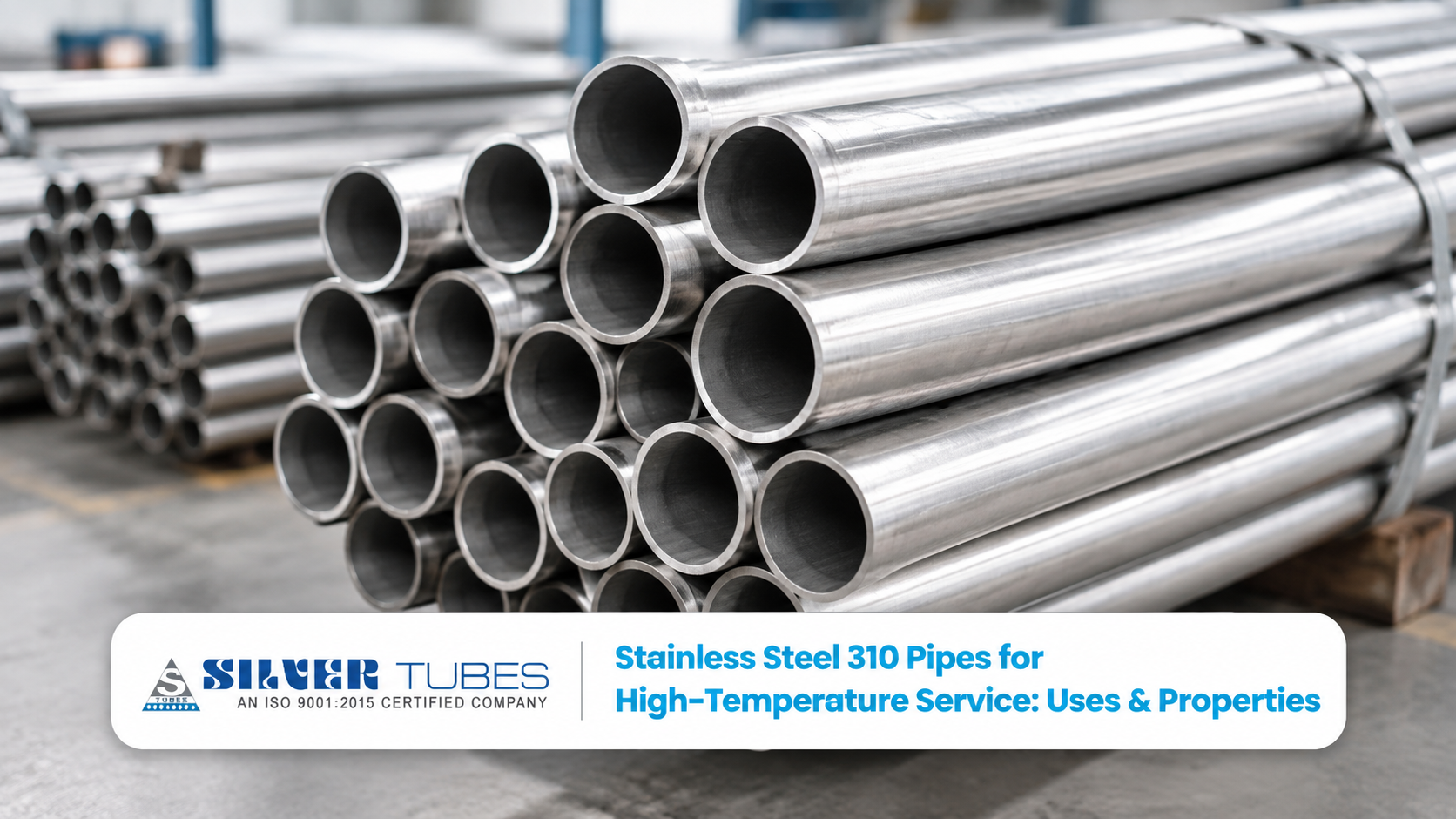
Furnaces, radiant tubes and heat-treatment fixtures put a lot of stress on metal. Ordinary pipe grades scale, warp or crack when the heat gets too high. Stainless Steel 310 Pipes hold up in conditions where standard austenitic grades start to give out. The chromium and nickel content is high, which is what gives these pipes their resistance to heat and oxidation. This article goes through the properties, the applications, and what to look at when selecting this grade for high-temperature work.
What Are Stainless Steel 310 Pipes?
Stainless Steel 310, listed under UNS S31000, is an austenitic stainless steel grade. It’s built around roughly 25% chromium and 20% nickel. That’s a lot more alloy content than you’d find in standard 304 or 316 grades. This is used in equipment that runs continuously at high temperatures, where lower-alloy steels lose strength or start scaling. Chromium forms a stable oxide layer on the surface. Nickel keeps the structure stable as temperatures rise. Between the two, Stainless Steel 310 Pipes are built for long, sustained heat exposure rather than the odd temperature spike.
Key Properties of SS 310 Pipes
High-Temperature Resistance
310 stainless resists scaling in continuous service up to around 1150°C. That’s why it turns up in furnace muffles, retorts and radiant tubes running long cycles without a break.
Oxidation Resistance
The chromium-rich surface layer limits oxide formation in suitable high-temperature conditions and cyclic operations. Keeps metal loss down and wall thickness intact through repeated heating and cooling.
Thermal Stability
310 pipe holds its shape during continuous heating. It resists the carbide precipitation that weakens lower-alloy grades over time, and thermal cycling causes less distortion than you’d see with standard austenitic pipe.
Mechanical Strength
Piping systems carry pressure and structural load even while hot. 310 stainless keeps its tensile strength well above the point where lower grades start to soften, so joints and supports stay secure.
Where Are 310 Stainless Steel Pipes Used?
Furnaces and Heat-Treatment Equipment
Furnace muffles, retorts, radiant tubes and heat-treatment fixtures use 310 pipe for structural parts facing direct flame or radiant heat, cycle after cycle, without losing shape.
Thermal Processing Systems
Industrial heating and processing operations, kiln components and conveyor systems included, use 310 pipe where the performance under sustained heat matters more than the upfront cost.
Petrochemical Industry
Refineries and processing plants specify 310 pipe for suitable high-temperature process lines, including sections exposed to hot process gases where a standard grade would scale.
Power Generation
Some high-temperature equipment and piping in power plants, boiler supports and combustion-zone components among them, use 310 pipe because the heat resistance is worth the extra cost.
Stainless Steel 310 Pipes vs Other Heat-Resistant Grades
Choosing between Stainless Steel 310 Pipes and other heat-resistant grades really comes down to the operating conditions of the job.
| Feature | Stainless Steel 310 | Other Heat-Resistant Grades |
| High-Temperature Performance | Suitable for demanding applications | Depends on grade |
| Oxidation Resistance | High in suitable conditions | Depends on grade |
| Thermal Stability | Good | Grade-dependent |
| Cost | Higher than standard grades | Depends on material |
Grades like 309 or 253MA can work fine for lower temperature ranges or different oxidation demands, and sometimes cost pushes buyers towards a lower-alloy grade instead of 310. It depends on the operating temperature, the atmosphere and the project budget.
How to Select UNS S31000 Pipes
Start with the actual operating temperature the line will see. Continuous exposure near 1150°C needs a different wall thickness than intermittent cycling does. Whether the heating is continuous or cyclic changes how much thermal fatigue the pipe takes on over its service life. The process environment matters too, oxidising, carburising or sulfur-bearing conditions all affect long-term performance differently. Pressure requirements, pipe size and wall thickness determine the schedule you need. Welding requirements and specifications such as ASTM A312 or ASME SA312 narrow things down further. And before finalising an order, confirm the material certificates and testing records are in order.
Quality Checks Before Buying
Before placing an order, check that the grade marked on the pipe actually matches what’s specified. Visual identification alone isn’t reliable enough. Check dimensions and wall thickness against the drawing, and go through the chemical composition and mechanical test results for compliance. Ask for Material Test Certificates for every batch, and confirm traceability where the project needs it. Silver Tubes checks all of this before dispatch, so what buyers receive matches the stated specification.
Conclusion
Stainless Steel 310 Pipes bring together heat resistance, oxidation resistance and mechanical strength, which is why they suit furnaces, thermal processing lines, petrochemical units and some power generation equipment. The right selection still comes down to operating temperature, atmosphere and cyclic conditions, not the grade on its own. Contact Silver Tubes for current stock and pricing on Stainless Steel 310 Pipes.