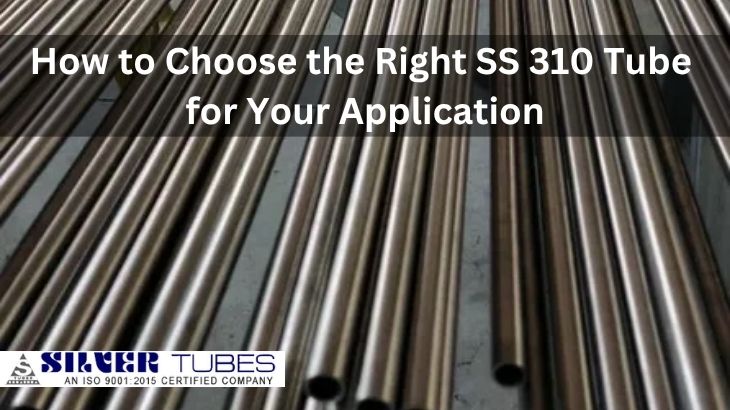
Choosing the right Stainless Steel 310 Tube depends on five factors: service temperature, corrosive exposure, dimensions, manufacturing route, and the standards applicable to the project. Grade 310 belongs to the austenitic family and serves furnaces, kilns and similar thermal equipment. As an exporter and stockist of stainless steel, Inconel, Monel, titanium and carbon steel, we stock tubes matched to actual service conditions. Each of the factors listed below affects cost, lead time, and service life.
Understand Stainless Steel 310 Tube
SS 310 Tube is an austenitic stainless steel tube containing 24 to 26% chromium and 19 to 22% nickel. That alloy content gives 310 Stainless Steel Tubes strong oxidation resistance: up to 1150°C in continuous service and 1035°C in intermittent service. Actual performance depends on the service environment, not the grade designation alone. Seamless and welded tubes are produced in this grade; the specification determines which applies.
Consider the Operating Temperature
Temperature sets the boundary for every other choice. Record normal and peak operating temperatures as separate figures. Thermal cycling matters as much as peak heat: repeated heating and cooling drives scaling and thermal fatigue. Heat Resistant SS 310 Tubes hold their protective oxide layer and useful strength in furnace internals and heat-treatment fixtures. Continuous exposure between 425°C and 860°C causes carbide precipitation, which weakens later corrosion resistance.
Evaluate Corrosion and Chemical Exposure
The service environment decides whether Grade 310 suits the line. List every medium the tube contacts: process gases, moisture, chlorides, acids and combustion products. Concentration and temperature both change the result. A fluid that is harmless at ambient temperature can damage the same tube at 300°C. Corrosion Resistant SS 310 Tubes perform well in oxidising atmospheres. The grade carries no molybdenum, so pitting resistance in chlorides stays limited. Grade 310 isn’t corrosion-proof.
Select the Right Tube Dimensions
The dimensions are determined by the system design, mechanical loading, installation space and the governing standard. Confirm six parameters before release.
- Outside diameter: Match OD to the connecting equipment; mismatches force reducers that add leak paths.
- Wall thickness: Thickness carries internal pressure plus the oxidation allowance.
- Tube length: State random, cut or fixed lengths. Fixed lengths reduce site welding.
- Schedule: Where schedules apply, confirm the schedule number with the nominal bore.
- Tolerances: Agree on OD, wall and straightness limits in writing, especially for tube sheets.
- Surface finish: Specify pickled, annealed, bright annealed or polished to suit the duty.
Choose Between Seamless and Welded Tubes
Construction type influences cost, available sizes and inspection scope. Neither type is better in the abstract; the duty determines which is more suitable.
- Seamless tubes: Pierced and extruded from a solid billet, with no longitudinal weld. Engineers specify them for high-pressure and high-temperature circuits.
- Welded tubes: Rolled from strip and welded along the seam. They offer tighter wall tolerance and larger diameters where the specification allows them.
Check Standards, Testing and Quality
Documentation separates a verified tube from an unqualified one. Check eight points before accepting a consignment.
- Applicable specification: ASTM A213 for seamless, ASTM A249 for welded
- Grade designation: 310, 310S or 310H (UNS S31000/S31008)
- Dimensional tolerances against the quoted specification
- Chemical composition limits and mechanical test requirements
- Material Test Certificate (MTC) with the shipment
- Heat and lot traceability marked on each tube
- Inspection records for hydrostatic, eddy current and NDT
- Surface finish and manufacturing requirements on the order
Match the Tube to the Application
Grade is used in through high-temperature process equipment. Eight groups cover most enquiries.
- Furnace and heat-treatment equipment: radiant tubes, muffles and fixtures
- Industrial ovens: recirculation ducting and internal supports
- Kilns: cooler tubes and burner pipework
- Heat exchangers: hot-gas duty where oxidation outweighs chloride damage
- Petrochemical and chemical processing equipment: reformer and cracking-unit internals
- Power-generation equipment: superheater and economiser support tubing
- High-temperature process systems: flue-gas and thermal-oxidiser lines
- Burner and combustion equipment: flame tubes, nozzles and preheat lines
Weigh temperature, atmosphere, fluid chemistry, pressure and fabrication before fixing the selection.
Conclusion
A correctly specified Stainless Steel 310 Tube matches the measured operating temperature, the corrosive exposure, the required dimensions, the seamless or welded choice, and the standards and test documents the project demands. Careful selection at the enquiry stage protects service life and avoids premature scaling, cracking and replacement.