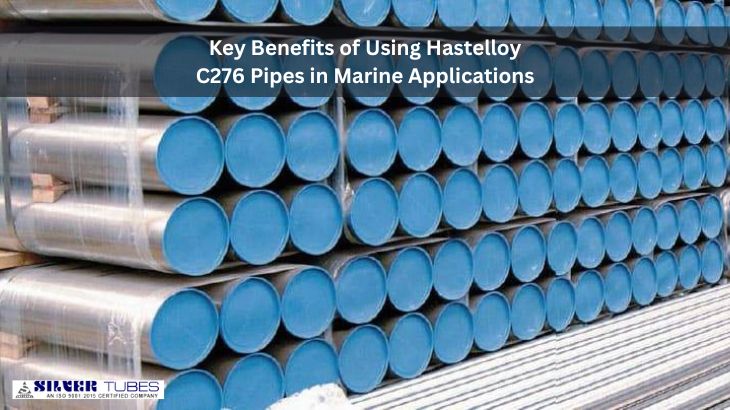
Marine environments are among the most corrosively aggressive environments in industrial service. Seawater contains chlorides, dissolved salts and biological compounds which continually act on metal surfaces, increasing corrosion, causing pitting and damaging the integrity of piping beyond what most onshore environments. Long term marine service requires corrosion resistance above that offered by standard stainless steels and carbon steel piping, leading to frequent maintenance or early replacement.
Hastelloy Alloy C276 Pipes are engineered to operate where ordinary materials cannot. This nickel-molybdenum-chromium alloy reliably resists pitting, crevice corrosion and oxidation. Review the Specifications for Hastelloy Alloy C276 Pipes for detailed material and dimensional data.
Benefits of Hastelloy Alloy C276 Pipes in Marine Applications
Exceptional Corrosion Resistance
Corrosion in seawater is what defines marine plumbing. Chlorides damage the passive film on ordinary alloys and induce pitting, a minor, localized attack which spreads and eventually results in structural failure. Hastelloy Alloy C276 Pipes provide better resistance to chloride attack than what is available from ordinary stainless steel grades. The alloy’s molybdenum percentage is specifically designed to combat pitting and crevice corrosion, providing steady resistance even in stagnant saltwater, where corrosion is most aggressively accelerated. This resistance is a big benefit for offshore platforms, subsea systems and components that are in salt water, and not just a little bit of a benefit, but a big benefit.
High Strength and Durability
Marine piping systems face mechanical loads from wave action, thermal cycling, and pressure differentials simultaneously. Hastelloy C276 pipes maintain their mechanical strength under these conditions without losing structural integrity over time. The alloy doesn’t soften, deform, or develop fatigue cracks under typical marine operating stresses. Long service life follows directly from this; durable systems built with C276 pipes require fewer replacements and significantly less unplanned maintenance than those built with lower-grade alternatives. That reduction in maintenance frequency translates directly into lower operational cost over the system’s design life.
Excellent Resistance to Chemical Exposure
Marine environments are not only corrosive due to seawater. Ships, offshore platforms and coastal processing facilities also handle acids, oxidizing chemicals and treatment compounds as part of normal operations. Hastelloy Alloy C276 Pipes are consistently reliable in both acidic and oxidizing environments, the kind of wide range of chemical exposures commonly found in marine chemical handling systems. It’s a material that doesn’t need to be replaced when process chemistry changes. That flexibility matters.
Superior Weldability and Fabrication
Piping installation in marine environment is often characterized by complicated routing, confined spaces, and field welding under severe conditions. Hastelloy C276 pipes are weld cleaned with conventional nickel alloy welding procedures and require no post-weld heat treatment in most marine service applications. This fabrication flexibility allows for faster, more economical installation with joint integrity throughout the system. Piping runs can be customized and fitted on site without impairing the corrosion resistance of the material in the weld zones, a real practical advantage in shipbuilding and offshore construction.
Reliable Performance in Extreme Temperatures
Marine systems operate across a wide temperature range, from cold deep-sea applications to high-temperature exhaust and heat exchanger service. Hastelloy C276 pipes maintain their structural integrity and corrosion resistance at both ends of this range. The alloy does not become brittle in low temperatures or lose strength in high service temperatures. This consistency is helpful in marine applications that are subject to thermal cycling, the repeated heating and cooling that causes expansion stress and ultimately weakens materials that cannot reliably handle the cycle.
Common Marine Applications of Hastelloy Alloy C276 Pipes
Hastelloy C276 pipes serve some of the harshest marine environments. Here is where the alloy consistently proves its corrosion resistance in real service.
Shipbuilding: Seawater ballast lines, bilge systems and hull piping where continuous seawater contact demands a material that holds up without protective coatings or frequent inspection.
Offshore Oil and Gas Platforms: Process piping, injection lines and instrumentation tubing in offshore environments where exposure to seawater, sour gas and high-pressure service create multi-threat corrosion environments that C-276 reliably addresses.
Desalination Plants: Brine handling lines, reverse osmosis system piping and evaporator connections where high chloride content and high temperatures preclude the use of most standard alloys.
Marine Exhaust Systems: High-temperature exhaust ducting on vessels and offshore generators where both thermal stress and corrosive combustion gases are present simultaneously.
Heat Exchangers: Shell and tube heat exchangers in marine cooling systems, where seawater is the cooling medium, a condition that demands pitting and crevice corrosion resistance at every contact surface.
Seawater Cooling Systems: Cooling circuits on ships, offshore platforms, and coastal industrial facilities where untreated seawater flows continuously through the system at varying temperatures and flow rates.
How to Choose a Reliable Hastelloy Alloy C276 Pipes Manufacturer
Certifications are the minimum requirement. A reputable Hastelloy Alloy C276 Pipes Manufacturer provides the material in accordance with the ASTM B622 (seamless) and ASTM B619 (welded) standards, with EN 10204 3.1 mill test certificates traceable to the original heat. This documentation is not optional for offshore and marine projects where material certification is a contractual and safety issue.
Product testing should be documented and standardized. PMI testing, hydrostatic pressure testing, dimensional inspection, and mechanical property verification should all be part of the manufacturer’s quality process. Ask for test records before confirming an order.
Global export capability is highly dependent on the ability of a company to support worldwide marine projects with the ability to provide consistent logistics and packaging that it help in maintaining the integrity of the goods during sea freight. Custom size availability includes non-standard sizes necessary for unique vessel or platform designs. Your project timeline is either safe or vulnerable to supply chain delays based on inventory depth and delivery reliability.
Conclusion
Hastelloy Alloy C276 Pipes have earned their place in maritime applications due to their corrosion resistance, mechanical durability, chemical adaptability and ease of manufacturing that no other standard alloys can provide in seawater service. The next step for engineers and procurement groups choosing piping for marine, offshore or desalination projects is to decide if C276 is suitable for the operating conditions and contact a certified manufacturer for specs and pricing.